Quick Summary
- Battery by car type: NS40 (~KES 6,200–8,500) for Vitz/Demio/March; NS60 (~KES 7,500–9,500) for Corolla/Fielder/Axio; NS70/N70 (~KES 11,000–16,900) for Noah/Harrier/older SUVs; N100–N200 for Land Cruisers, trucks and gensets.
- Match the terminal layout — the 'L' in NS60L means left-positive. Wrong polarity is a fire risk, not just a fitment issue.
- Chloride Exide Powerlast is the local benchmark; Rocket, Solite, Willard, Delkor and AtlasBX are the quality imports. Expect 12–24 month warranties from genuine dealers.
- Oil by engine: 5W-30 synthetic for modern imports, 10W-40 semi-synthetic for 2000s saloons, 15W-40/20W-50 mineral for high-mileage engines, diesel-rated 15W-40 for Hilux/Prado/trucks.
- Realistic prices: Total Quartz 5000 20W-50 ~KES 2,200–3,000/4L; Shell Helix HX5 ~KES 2,350/4L; HX7 ~KES 3,500/4L; Rimula diesel ~KES 3,000/5L.
- Fake oil is rampant — buy from branded stations and authorised dealers, verify seals and batch codes, and never mix ATF, gear oil, brake fluid or coolant with engine oil.
Part 1 — Battery group sizes in Kenya (JIS & DIN)
Kenya's fleet is dominated by Japanese imports, so most batteries here are JIS-coded — the NS and N series. European cars (VW, Mercedes, BMW, Range Rover) use DIN sizes instead. The code printed on your old battery is the single most reliable buying reference: it encodes case size, capacity class and terminal layout.
The terminal layout matters as much as the size: in JIS naming, a trailing L means the positive terminal sits on the left when the posts face you. An NS60L and an NS60 are not interchangeable without stretching cables — and reversed polarity can blow fuses and fry electronics.
| Size code | Capacity / CCA | Typical vehicles in Kenya | Price (KES) | Note |
|---|---|---|---|---|
| NS40 / NS40L (JIS 035) | ~35Ah, ~300 CCA | Toyota Vitz, Passo, Starlet; Nissan March; Mazda Demio; Honda Fit; Suzuki Alto | KES 6,200 – 8,500 | The most common small-car battery in Kenya; 'L' = left-positive terminals |
| NS60 / NS60L (JIS 045) | ~45Ah, ~350–400 CCA | Toyota Corolla, Fielder, Axio, Allion, Premio; Nissan Tiida; Honda Fit shuttle | KES 7,500 – 9,500 | Default battery for Kenya's 1,300–1,800cc saloon fleet |
| NS70 / N70 (JIS 065–075) | ~65–75Ah, ~500–600 CCA | Toyota Noah/Voxy, Wish, Harrier, Mark X; Subaru Forester; older Prado | KES 11,000 – 16,900 | Bigger case and capacity for MPVs, SUVs and 2,000cc+ engines |
| N70 / D31 class | ~70–80Ah, ~600+ CCA | Toyota Hilux diesel, Land Cruiser Prado diesel, Mitsubishi Pajero | KES 14,000 – 19,000 | Diesel engines need the extra cranking power — don't undersize |
| N100 / N100MF | ~100Ah | Toyota Land Cruiser 70/80/100, Hiace diesel, Isuzu NPR, Canter | KES 18,000 – 24,000 | Commercial and large-SUV standard; AtlasBX N100MF ~KES 18,000–20,000 |
| N120 | ~120Ah | Larger trucks, buses, gensets, construction equipment | KES 24,000 – 30,000 | Often sold in pairs for 24V truck systems |
| N150 | ~150Ah | Isuzu FSR/FVR, Hino trucks, large gensets, solar banks | KES 30,000 – 38,000 | Atlas 150MF listed around KES 37,900; also used off-grid |
| N200 | ~200Ah | Heavy trucks, marine, large generators, solar installations | KES 38,000 – 48,000 | Heavyweight class — confirm tray size and terminal layout |
| DIN sizes (44/55/60/74/100) | 44–100Ah | VW Polo/Golf, Mercedes C/E class, BMW 3/5 series, Range Rover | KES 14,000 – 30,000+ | European cars use DIN not JIS sizes; AtlasBX DIN100 ~KES 27,000 |

Read the code on the top label — it tells you the JIS/DIN size, capacity and polarity at a glance. Image: Wikimedia Commons.
CCA, Ah and reserve capacity — what actually matters
Three numbers describe a battery. Ah (amp-hours) is total energy storage — an NS40's ~35Ah runs your radio and lights longer than you'd think, while an N200's 200Ah can deep-cycle a genset or solar bank. CCA (Cold Cranking Amps) is the burst current available for starting — diesels need more because high compression is harder to crank. Reserve capacity is how long the battery can run the car if the alternator dies — useful on long upcountry stretches.
The Kenya-specific nuance: we don't fight −18°C cold starts, but we fight heat. Sustained 30°C+ temperatures accelerate the chemical ageing inside lead-acid batteries, which is why quality batteries here last 2–4 years rather than the 4–6 you see quoted in European reviews. Matatu-style idling and constant short trips (never fully recharging) shorten life further — if your daily drive is town-centre hops under 15 minutes, expect the shorter end of the range.
Battery brands in Kenya: prices and warranty norms
Chloride Exide assembles batteries locally and runs the widest warranty network — you can claim in most towns. The Korean brands (Rocket, Solite, Delkor, AtlasBX) compete on plate quality and CCA; Willard is the South African option engineered for hot, rough-road conditions. Prices below are Nairobi street prices from September 2026; upcountry pricing adds logistics cost.
| Brand | Origin | Typical prices | Warranty | Reputation |
|---|---|---|---|---|
| Chloride Exide (Powerlast) | Made in Kenya | NS40 ~KES 6,200–7,800; NS60 ~KES 7,500–8,500; N70 ~KES 15,600–16,900 | 12–24 months | Kenya's default choice — assembled locally, nationwide dealer and warranty network, Powerlast is the maintenance-free line |
| Rocket | South Korea | NS40 ~KES 6,500; NS60 ~KES 8,000–9,000; N70 ~KES 14,000–16,000 | 12–18 months | Popular Korean import, strong resale reputation among fundi mechanics |
| Solite | South Korea (Hyundai Sungwoo) | NS60 ~KES 8,500–10,000; N70 ~KES 15,000–18,000 | 12 months typical | OEM supplier to Hyundai/Kia — factory-fitted on many Korean cars in Kenya |
| Willard | South Africa | N50 ~KES 9,000; N70 ~KES 14,000; N100 ~KES 19,000; N200 ~KES 32,000+ | 12–25 months | Built for African heat and rough roads; strong in truck and 4x4 circles |
| Delkor | South Korea (Clarios) | N100 ~KES 20,000–24,000; N150 ~KES 30,000+ | 12–24 months | Premium Korean brand favoured for commercial fleets |
| AtlasBX | South Korea | N70 ~KES 15,000; N100MF ~KES 18,000–20,000; 150MF ~KES 37,900 | 12–24 months | X-Frame grid technology, good CCA-per-shilling; common at battery specialists |
| MNB / Union / budget brands | Various | NS40 from ~KES 5,000; N70 from ~KES 10,000 | 6–12 months | Cheapest options — fine for low-demand use, but expect shorter life |
Warranty reality check: '12 months' means free replacement for a manufacturing defect, not wear. Keep the receipt and warranty card, and note that many dealers pro-rate claims after month six. A battery killed by a faulty alternator or left discharged for weeks is not a warranty case — test the charging system (should read ~13.8–14.4V running) when you fit the new battery.
When to replace — and how to make it last
Replace when you see
- Slow, lazy cranking on a warm morning
- Dashboard dimming when you start the car
- A swollen case or rotten-egg smell
- Needing jump-starts more than once a month
- Battery older than ~3 years with any symptom above
Make it last
- Drive 20+ minutes weekly to fully recharge
- Keep terminals clean and clamps tight (vibration kills cells)
- Don't leave lights/trackers draining a parked car for weeks
- Test the alternator annually — over- and under-charging both kill batteries
- Maintenance-free still means check the hold-down bracket

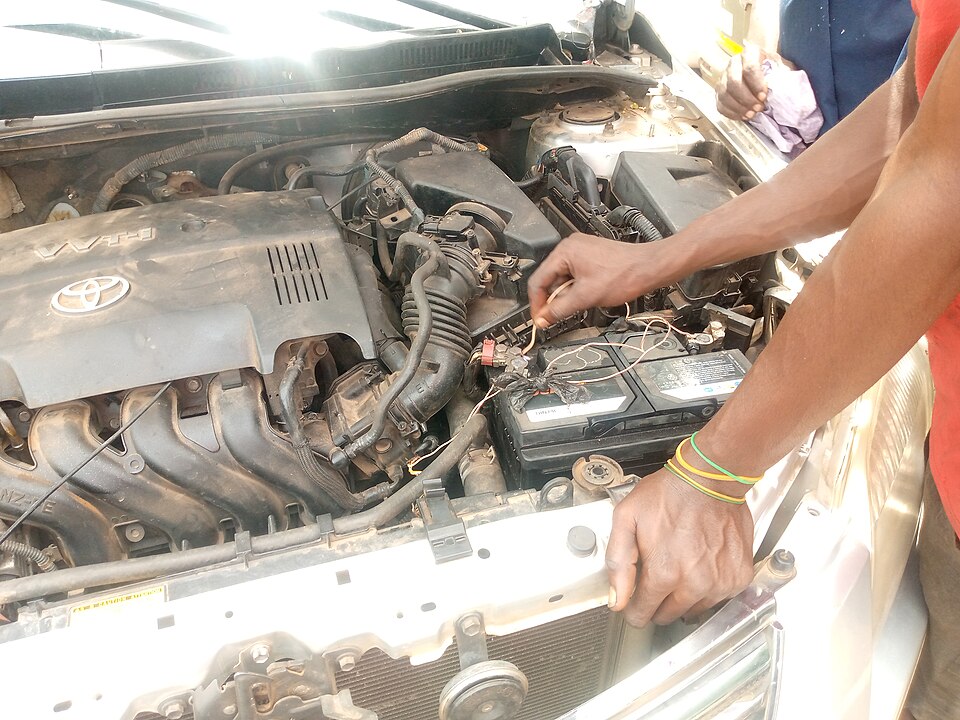
Most Kenyan battery shops fit free and take your old battery — it has scrap-lead value, so ask for the trade-in discount. Image: Wikimedia Commons.
Part 2 — Engine oil: viscosity decoded for Kenyan conditions
The numbers on the bottle describe how the oil flows: in "10W-40", the W number is cold-start flow (lower = thinner when cold, protects the engine in the first seconds after starting), and the second number is thickness at operating temperature. Kenya's climate removes most cold-start worries — the real question is engine age and design. Also decode the API code: S- (SN, SP) is petrol-rated, C- (CI-4, CK-4) is diesel-rated, and many oils carry both.
| Grade | Type | Best for (Kenya) | Notes |
|---|---|---|---|
| 5W-30 | Full synthetic | Modern engines: Vitz/Note/Demio 2010+, turbo petrols, hybrids | Flows fast at cold start, best fuel economy; what most 2015+ Japanese imports specify |
| 10W-40 | Semi-synthetic | Corolla/Fielder/Axio 1.5–1.8, Premio, Allion — Kenya's workhorse saloons | The all-round Kenyan default; Shell Helix HX7 ~KES 3,500/4L |
| 15W-40 | Mineral | Older petrol engines, light diesels, matatu-era Toyotas | Cheap and forgiving; Shell Helix HX5 ~KES 2,350/4L |
| 20W-50 | Mineral | High-mileage engines, older 1Y/2Y/3Y/5K units, engines burning oil | Thick protection for worn tolerances; Total Quartz 5000 ~KES 2,200–3,000/4L |
| 15W-40 (CI-4/CK-4 diesel) | Mineral/semi-synthetic heavy-duty | Hilux, Prado, Land Cruiser, Isuzu D-Max, trucks and gensets | Diesel-rated oils only — Shell Rimula, Mobil Delvac, Total Rubia |
Mineral vs semi vs full synthetic in one line: mineral oils (KES 2,000–3,000/4L) protect fine but degrade by ~5,000km; semi-synthetics (KES 3,500–5,500/4L) stretch to ~7,500km; full synthetics (KES 5,500–9,000/4L) hold 10,000km and protect turbos. The oil filter changes every time, no exceptions.
Oil brands and prices in Kenya
All the global majors sell here, plus strong local-network brands. The table gives real 4L/5L street prices from September 2026 across service stations, spares shops and Jumia.
| Brand | Typical products & prices | Notes |
|---|---|---|
| Shell Helix (HX5/HX7/Ultra) & Rimula/Spirax | HX5 15W-40 ~KES 2,350/4L; HX7 10W-40 ~KES 3,500/4L; Ultra 5W-30 ~KES 5,500–7,000/4L; Rimula R3 diesel ~KES 3,000/5L | Widest dealer network in Kenya; Rimula is the truck/bus diesel standard |
| Castrol GTX / Magnatec / Edge | GTX 20W-50 ~KES 2,250–2,700/4L; Magnatec 10W-40 ~KES 4,500–5,500/4L; Edge 5W-30 ~KES 6,000–7,500 | Magnatec's cling molecules suit Nairobi stop-start traffic; Edge for newer engines |
| TotalEnergies Quartz / Rubia & Elf | Quartz 5000 20W-50 ~KES 2,200–2,769/4L; Quartz 7000/9000 for newer cars; Rubia for diesels | Blended/packed partly in Kenya; excellent mineral-oil value, Total service stations countrywide |
| Mobil (Mobil 1 / Super / Delvac) | Mobil Super ~KES 3,000–4,000/4L; Mobil 1 5W-30 ~KES 7,000–9,000; Delvac MX 15W-40 for diesels | Mobil 1 is the premium synthetic benchmark; Delvac is the fleet-diesel favourite |
| Havoline (Caltex/Chevron) | Havoline 20W-50 and 15W-40 ~KES 2,500–3,500/4L | Solid mid-price mineral oils common at Caltex-linked stations |
| Ola Energy Accel / DeoMAX | Accel petrol oils and DeoMAX diesel oils, ~KES 2,000–3,000/4–5L | Kenyan fuel-retailer brand; honest budget option sold at Ola stations |
| Engen | Engen Xtreme/Dieselube range ~KES 2,200–3,500/4–5L | SA-origin oils sold at Engen stations; reliable mid-range |
| Liqui Moly & Motul | 5W-30/5W-40 synthetics ~KES 5,500–9,000/5L | German/French premium synthetics for German cars, turbos and performance engines |

Topping up between changes is normal on high-mileage engines — check the dipstick monthly. Image: Wikimedia Commons.
ATF vs gear oil vs brake fluid vs coolant — never mix them
"Oil is oil" is the most expensive myth on Kenyan roads. Each fluid is a different chemistry doing a different job, and the wrong one in the wrong system causes damage measured in tens of thousands of shillings.
| Fluid | Job | Common grades | Warning |
|---|---|---|---|
| Engine oil | Lubricates engine internals | 5W-30 / 10W-40 / 15W-40 / 20W-50 | Petrol (API S_) and diesel (API C_) ratings differ — match both letters to your engine |
| ATF (automatic transmission fluid) | Hydraulic fluid + lubricant for automatic gearboxes | ATF D-III, ATF WS (Toyota), CVT fluid (Nissan/Honda CVTs) | NEVER put engine oil or gear oil in an automatic — wrong ATF destroys gearboxes |
| Manual gear oil | Lubricates manual gearboxes and differentials | 75W-90, 80W-90, 85W-140 (GL-4/GL-5) | GL-5 in a GL-4 box corrodes synchros; LSD diffs need friction-modified oil |
| Brake fluid | Hydraulic pressure for brakes and clutch | DOT 3 / DOT 4 (~KES 400–800/L) | Hygroscopic — replace every ~2 years; never use oil of any kind in brake systems |
| Coolant / antifreeze | Engine cooling, corrosion protection, boil-over margin | Ethylene-glycol green/red/OAT (~KES 600–1,500/L) | Don't mix colours/chemistries; Kenyan heat still needs proper coolant, not plain water |
The classic Kenyan mistake: pouring engine oil into an automatic gearbox or CVT "to top up". A Nissan Note's CVT needs specific CVT fluid (~KES 1,200–2,000/L); the wrong fluid means a KES 200,000+ gearbox rebuild. Same story with coolant: plain tap water corrodes the system and boils over in Nairobi traffic — use proper ethylene-glycol coolant mixed as directed.
Service intervals: the Kenyan reality
Every manual says "or sooner under severe conditions" — and Nairobi commuting qualifies: hours of idling in traffic, dust that slips past filters, fuel quality variation, and short trips that never fully warm the oil. The sensible local schedule:
- Mineral oil (15W-40/20W-50): every 5,000km with filter — this is what most Kenyan mechanics recommend and it matches the oils' real lifespan in traffic.
- Semi-synthetic (10W-40): every 7,000–8,000km.
- Full synthetic (5W-30/5W-40): every 10,000km, or 12 months, whichever first.
- ATF: every 40,000–60,000km for conventional autos; CVTs every ~40,000km with correct fluid.
- Brake fluid: every 2 years (it absorbs moisture and lowers boiling point — a real issue on long descents like the Mai Mahiu escarpment).
- Coolant: every 2–3 years or per manufacturer; check the level monthly.

A monthly dipstick check catches oil-burning engines before they run dry — the cheapest maintenance habit there is. Image: Wikimedia Commons.
How to spot fake engine oil in Kenya
Counterfeit and refilled oil is a documented problem in the Kenyan market — drained oil is re-filtered, rebottled in convincing Shell/Castrol/Total packaging and sold at tempting prices. It provides almost no additive protection and can destroy an engine in one interval. Run these checks before the bottle is opened:
Seal and cap
Genuine Shell, Castrol and Total bottles have an induction foil seal under the cap and a one-piece tamper ring. A re-glued seal, mismatched cap colour or missing foil means the bottle may have been refilled with reclaimed oil.
Batch code and QR verification
Look for a laser-etched or inkjet batch/date code on the bottle that matches the carton. Castrol and Shell run SMS/QR verification — scratch or scan and confirm before the mechanic opens it.
Label print quality
Blurry logos, spelling errors, wrong fonts or a label that peels like a sticker rather than being moulded into the bottle are classic counterfeit tells.
Price sanity check
Shell Helix HX7 4L selling for KES 1,500 when every legitimate shop charges ~KES 3,500 is not a bargain — it's fake. Prices below about 60% of typical retail should trigger suspicion.
Where you buy
Buy from branded stations (Shell, Total, Ola, Engen), authorised dealers, or established auto spares shops — not roadside display racks. Groove/street-side 'offer' oil is where most counterfeits circulate.
Oil appearance and smell
Fresh oil is clear amber and smells neutral. Dark, gritty or fuel-smelling 'new' oil is reclaimed product. Also confirm the quantity — short-filled 3.5L bottles sold as 4L are a known trick.
Same logic applies to batteries: insist on a sealed unit with a stamped warranty card, check the manufacturing date code (batteries age on the shelf), and buy from a dealer who will honour the claim — a receipt from a named shop is your warranty's lifeline.
FAQs
How much does a car battery cost in Kenya in 2026?
For the common JIS sizes: an NS40 (Vitz, Demio, March) runs KES 6,200–8,500; an NS60 (Corolla, Fielder, Axio) KES 7,500–9,500; an NS70/N70 (Noah, Harrier, older Prado) KES 11,000–16,900; an N100 (Land Cruiser, Hiace diesel, Canter) KES 18,000–24,000; and N150/N200 truck and genset batteries run KES 30,000–48,000. Chloride Exide Powerlast is the value reference; Rocket, Solite, Willard, Delkor and AtlasBX cost a bit more.
What do the codes like NS60L and 045 mean on a battery?
They are JIS (Japanese Industrial Standard) group sizes. NS60 means a ~45Ah small-standard case, and the 'L' marks left-positive terminal layout — critical because fitting the wrong polarity can make cables too short or cause dangerous connections. The '045' is the JIS performance rating code. European cars instead use DIN sizes like DIN55 or DIN100. Always match the code printed on your old battery.
What is CCA and how much do I need in Kenya?
CCA (Cold Cranking Amps) measures how much current the battery can deliver to crank the engine. Small petrol cars need ~300–350 CCA (NS40/NS60), 2.0L+ petrols and MPVs ~450–600 (NS70), and diesels 600+ because compression is harder to turn. Kenya's warm climate is gentler on cold starts than Europe, but diesel engines and vehicles parked for long periods still need honest CCA — buy the size your car specifies, not a smaller cheaper one.
Which engine oil should I use in Kenya — 5W-30, 10W-40 or 20W-50?
Follow the owner's manual first. As a Kenyan rule of thumb: 2010+ Japanese imports (Vitz, Note, newer Corolla) typically take 5W-30 or 0W-20 synthetic; 2000s-era saloons (Fielder, Premio, Allion) run happily on 10W-40 semi-synthetic; high-mileage engines that burn oil or older 1Y/3Y/5K units take 15W-40 or 20W-50 mineral. Diesels (Hilux, Prado, D-Max, trucks) need diesel-rated 15W-40 such as Rimula, Delvac or Rubia. Kenya's heat does not mean 'thicker is always better' — modern engines with tight tolerances can be damaged by 20W-50.
How often should I change engine oil in Kenya?
The realistic intervals: mineral oil (15W-40/20W-50) every 5,000km; semi-synthetic 10W-40 every 7,000–8,000km; full synthetic 5W-30 every 10,000km — but shorten these if you sit in Nairobi traffic daily, drive dusty upcountry roads, or make many short trips, because all three count as 'severe service' in every manufacturer's schedule. Always change the filter with the oil.
How do I know if engine oil in Kenya is fake?
Check five things: intact induction foil seal and unbroken tamper ring under the cap; a batch/date code matching the carton that verifies via the brand's SMS/QR check; sharp label printing with no spelling errors; a price within ~70–100% of normal retail (Shell HX7 is ~KES 3,500/4L — 'KES 1,500 special offer' is fake); and a reputable seller — branded stations and established spares shops, not roadside racks. When in doubt, buy from the brand's service station network.
Sources
- Jemspark Kenya: Chloride Exide NS40 specs and price
- IMAR Auto Tyres: NS60L Chloride Exide price and fitment list
- Lightbell Enterprises: Chloride Powerlast NS40/NS60/NS70 prices
- Skyniks: AtlasBX N100MF battery Kenya pricing
- Battery Express Kenya: Atlas 150MF heavy-duty battery
- One Stop Auto Garage: Castrol GTX 20W-50 4L price
- Jumia Kenya: TotalEnergies Quartz 5000 20W-50 4L listing
- IMAR Auto Tyres: Shell Helix HX7 10W-40 Nairobi price
- Polish Venture Kenya: Shell Rimula R3 15W-40 diesel oil 5L
- Mobil Kenya: Delvac MX 15W-40 heavy-duty diesel oil data sheet